What is it like inside New Zealand's biggest school?
Thu, 13th Aug 2026 (Today)
One Friday lunchtime, a queue of Rangitoto College students snakes around the sprawling 23-hectare campus for a world record attempt at the most high-fives in an hour.
At Rangitoto, "every day, there's new people winning big things," says Year 13 head student Joshua Wang, who earned special recognition for scoring 10 scholarships last year.
The school in Auckland's North Shore is the kind of place where students casually discuss how one of their peers qualified for the Commonwealth Games, and where asking for "the principal" might prompt the question: "Which one?"
There are more than 250 teachers and 90 support staff, including five principal deputies and three associates, for a roll size of more than 4000 students - the biggest roll in the country apart from home-schooling, although not the biggest in terms of campus size.
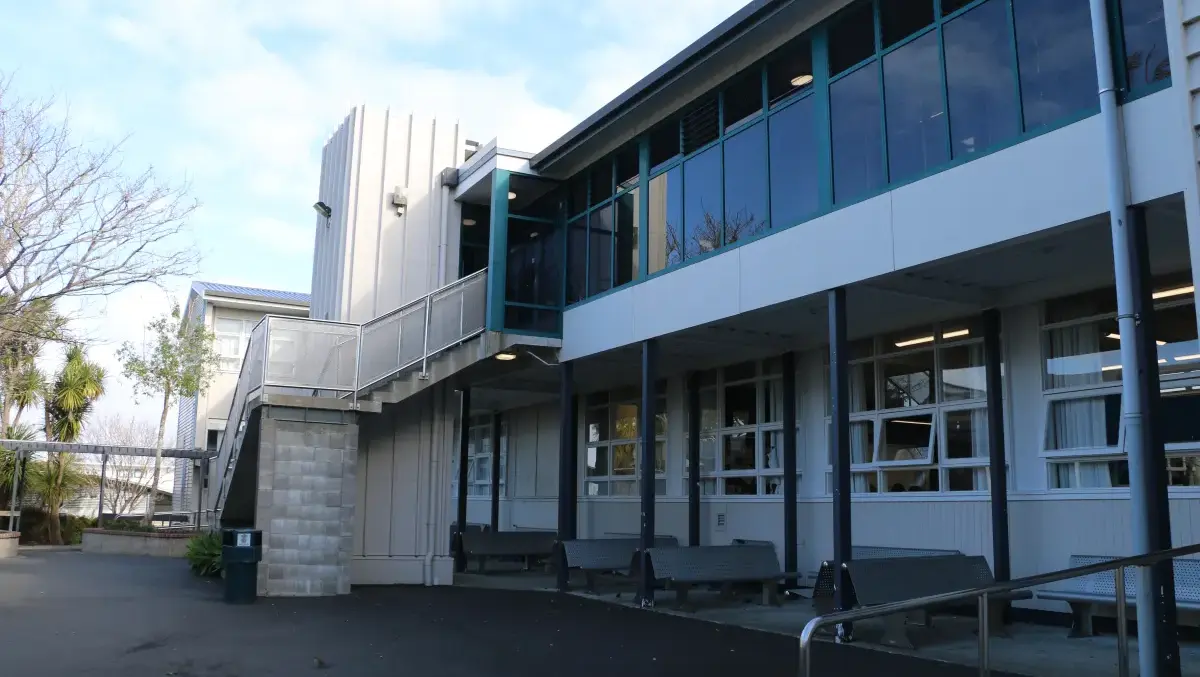
When it rains, students take cover on the edges of blocks which have ample seating and are lined with signs bearing the school's values: "pride", "respect", "integrity", "courage" and "excellence".
And who better to represent those than Joshua and fellow head students Ryen Anderson, Maya Al-Damluji and Brody Donald?
They admit the campus can feel daunting at first. But they say the sheer number of students means help is around every corner, alongside peer programmes and deans who stay with the same cohort throughout their school years.
"I did get lost on my first day at Year 9. But everyone does. After a day, you're so used to [the campus]," Maya says. "You always feel a sense of belonging and whanaungatanga, even with younger students. I've met so many year 9s and 10s, and they know me as well. So there's like connections between cohorts."
Asked which features stand out most at Rangitoto, the group hesitates for a moment - they don't know where to begin.
The impressive layout features 152 classrooms, several fields (including "arguably one of New Zealand's most scenic rugby fields"), an "Olympic standard" hockey turf that's "the envy of many in the region", an indoor cricket centre with a bowling machine, 22 purpose-built science labs, a dance studio offering sprung floors and a full lighting rig and three gymnasiums.
Students can order lunch through an app, access an on-site physio and use facilities shared with AUT Millennium, including a fitness centre, pool and track.
Despite its size, the head students say they can get to class within five minutes, because the fields surround a centralised hub of classroom blocks.
Dealing with growing demand
The roll has grown from just over 3000 students in 2010 to 4081 last year and it continues to grow, forcing the school to decline all out-of-zone enrolment requests this year. Principal Greg Thornton says the school is operating at 102 percent capacity, with three non-teaching spaces being used as classrooms.
Bulging classroom capacity issues across the board have been in the headlines for several years as schools deal with population growth and housing intensification. The last high school that opened on the North Shore was Albany Senior High School in 2009.
"We have a fairly large site, but the demand for resource that this many students place is an ongoing challenge," Thornton says. "You can easily imagine how quickly our 450 basketball players use up the three gym spaces that we've got."
Ten classrooms will be included in a new visual arts block next year, while another eight are planned for 2028. The issue isn't just around resourcing, but also the logistics, such as bus rides, and where to place extra classes on the hillside site, Thornton says.
Although some parents may initially express concern "that what was special about this place might be threatened or under challenge if it grows", Thornton says student care and connection is at the core of their mission.
"It does go back to that intimacy of making sure that the students are connected. They find their own space around the campus where it doesn't feel like 4000 people all at once."
Why do so many want to go to Rangitoto College?
Brody Donald, whose grandmother and father attended the school, considered other local options but was ultimately drawn by the opportunities on offer. Ryen and Joshua also have family ties to the school, but opportunities and involvement are highlights for them too.
"I think before even attending the college, I was like 'I want to be wearing the red blazer in a few years' time'," says Maya, the first in her family to attend Rangitoto.
There's also "tuition for pretty much every instrument that you can think of", she adds.
The school offers more than 30 sports codes, 75 performing arts groups and more than 75 clubs, spanning everything from the traditional offerings of music, arts and debating to the more niche like Chinese yoyo (diabolo), Dungeons and Dragons, juggling and Rubik's cube. Maya leads 10 clubs, including one that helps retirement village residents with technology.
"Teachers and the staff give us the freedom to be able to take these opportunities," Ryen says. "A lot of these clubs are student-led, so students take the initiative to make it a club and get other kids involved."
Brody, who has helped out in most productions since Year 9, is passionate about the auditorium. He says it can transform "from a boring assembly hall to a state-of-the-art" space for festivals and theatre shows.
Another drawcard for Joshua was the dual-curriculum pathway. Students complete an advanced Rangitoto Diploma in Year 11 before choosing between NCEA and the International Baccalaureate Diploma Programme.
The school recorded a national-leading 348 scholarship passes last year, the sixth time it has topped the country.
With 50 science teachers on hand and four shiny trophy cabinets lining the auditorium corridor, its clear students have made a mark. Yet Thornton says success isn't defined solely by academic achievement. He smiles recalling how a group of students who play UNO "unlike you've ever seen" dragged him in for a game or two during lunch.
It's not about "squeezing kids to be performing at the highest in everything they do, but it is asking them to build connections outside of the classroom, to develop themselves more broadly, to make friends and to develop all of that social well-being".
Thornton's own ties to the school run deep. He and his wife attended Rangitoto, their daughter is now a student, and his father-in-law helped build Te Rangi, the Year 13 study space.
After graduating in 1994, Thornton returned as a teacher in 2003 before moving into other roles and returning as principal this year. Some of the staff that taught him were present on his return.
"It can be quite hard to drop the Mr or Mrs and substitute that with a first name, especially with some of the staff that I knew fairly well.
"The success of this place is born off an amazing contribution from staff over many years."
Two of those staff - an associate principal and deputy principal - were recently recognised for 35 years of service.